
Weather Travel What the Papers Say TV GuideLeisure
Site search Web search
powered by FreeFind
Home What's new History Our Area Districts Photo Gallery Features Memories Genealogy Webshop Advertising Miscellany Business Links

Maltby Pit Disaster of 1923

28th July, 1923

Maltby, one of the largest centres of development in the South Yorkshire coalfield, was the scene of a disaster, only less in extent than that which occurred eleven years previous at the neighbouring Cadeby Main Colliery.
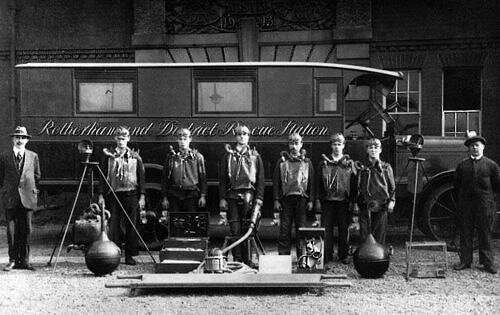
Twenty-seven men lost their lives in the Maltby Main Colliery Company's pit, situated in thick woodland about a mile from the village, in consequence of an explosion which occurred in the pit early on 28th July, 1923. Only one body, that of a man named Renshaw, was recovered despite the effort of rescue parties. The rescue was abandoned after 12 hours when all hope of the possibility of any man still in the mine being alive was been given up.

A statement was issued at 2 o’clock on 28th July:

Rescue Party

As soon as possible after the accident occurred rescue parties were formed, and upon investigation made up two sets of parties. We were fully satisfied that none of the men imprisoned in the mine could possibly be living. Deliberations between representatives of the owners and management, H.M. Inspectors, and workmen are still being held, and a definite conclusion as to the policy to be adopted has not yet been arrived at. It may be taken for certain, however, that there is no hope of recovering the bodies of the dead for the time being.

This statement was signed by Herbert Shaw and H. Ross, miners' delegates; Herbert Smith. president of the Miners' Federation; Basil H. Pickering, the colliery agent; and E. Dunn, colliery checkweighman.

THE KING'S MESSAGE

The following message was received by the Manager of Maltby Colliery:

The King and Queen are very distressed to hear ol the disastrous explosion, and are anxious to learn any particulars of the condition of the sufferers.

Colonel Lane-Fox, M.P., Secretary for Mines, sent a telegram from Tadcaster expressing sympathy with the relatives and asking for further news.

Later a further official statement was issued;

As a result of deliberations held today it has been decided to erect certain stoppings close to the pit bottom with the object of at some future date, which it is hoped will not be far distant, being able in safety to reopen the majority of the workings in the mine. These stoppings will be erected by volunteers from the official staff of the colliery.

About 2,500 men were out of work for an indefinite period - serious for the village which had a population of 13,000 wholly dependent on the Maltby mine. It was suggested that at the very earliest, three or four weeks would elapse before the colliery could be reopened.

The full list of men left in the pit after the explosion, all residents in Maltby, and nearly all married:

The Iast named is the man whose body was recovered by the first rescue party who stated that he was 'in a crouching attitude, with both arms drawn up across the face as if to protect it from the flame and shock of the explosion'.

Maltby Pit

The following official account was given at 9.45 pm on the night of the accident, when the second rescue party had returned to the surface and operations had been discontinued for the day. The statement was the result of a conference attended by Mr. W. B. M. Jackson, Managing Director of the Colliery Company, Mr. Maurice Deacon, another director and the colliery officials:

The explosion occurred at 9.15 a.m. at the stoppings that were being put in 53 S cross road. The force of the explosion was felt at the bottom of 95 S cross gate, where two deputies were working, but these men got clear. The first rescue party found one body a hundred yards in by from the junction of 95 S cross gate on the east plane. All men were then withdrawn from the pit. A second rescue party went down at 6 o clock to-night but owing to falls in the road they could not get into the area where the explosion occurred. From the signs of violence found by the party there can be no hope of anyone being still alive. The second party returned at 8 oclock.

The explosion appeared to be a sequel to, if not the result of gob fires, which caused a cessation of work 16 days previous to the accident. There were 130 men in the mine at the time of the explosion. These men had gone down at 5 o’clock in the morning to resume their work at the stoppings of the gob fires, and they were distributed in parties of various sizes at the different gob holes where fire had occurred. The sentence in the official statement, 'All men were then withdrawn from the pit', refers to the men, about a hundred in number, who were in the pit, but not involved in the accident.

Gob fires are smouldering outbreaks in the heaps of debris with which the gob holes, or worked out places in the coal seam, are filled. They are extremely difficult to quench, and, of course dangerous in fiery mines such as those of the Barnsley Thick Seam. This seam, which dips to the east, was worked at a depth of about 850 yards and the Maitby mine was known to be hot and gassy. The gob fires had been a source of intermittent trouble for several years, and the difficulty had been increasingly costly to deal with since the coal stoppage of 1921.

The fire had developed 16 days before the explosion, and on 13th July it was thought advisable to suspend coal-getting entirely. The management took every possible step to combat the fire and, recognising the interest and concern of the men they agreed to the formation of a consultative committee of coIIiery officials and miners in the South Yorkshiie coalfield to suggest measures for dealing with the outbreak. As the result of an examination of the workings it was decided on July 21st to seal the area affected by the gob fire and to inject inert gas. It was believed that this would be effective, and that an early resumption of coal getting in the mine would be possible. During the week from July 21st to the 29th, it was reported to the consultative committee that work was proceeding satisfactorily and the management asked for a hundred more men to expedite the work on the stoppings round the gob fire area, the request was approved by all concerned, and this accounts for the large number of men who were down the pit in such circumstances.

In the effort to put out the fire, bricks, mortar and sandbags were used to build up the barrier intended to smother the fire. The work consists of erecting walls of sandbags from floor to roof all round the afflected place. The effect of the explosion was to blow these stoppings out and to bring down the roof all round, so fire and gas had free play, and communication was impossible.

A MINER'S STORY

The explosion occurred in a byway off the main haulage road on the east plane at a distance of 1300 yards from the shaft. Nothing was heard of it above ground.

James Bamborough, who was at work in the mine not far from the explosion, says he was with party of a dozen men in No. 5 district in the north-west part of the pit. This was one of several such parties who were 'gobblng' that is, attempting to block up gob holes where there was fire. Two of the colliery's rescue team were in his party. They heard the explosion which appeared to be in the middle east district between sections 53 and 95. Bamborough when asked what he himself heard of the explosion replied:

'She went once when we were in and some chaps got gassed by the explosion and had to come out. We were then sent to 53 section to relieve them, and just as we were going along the wind suddenlly changed, that is, the ventilation had been reversed. She must have gone off somewhere else. (This was evidently the twin explosion which Bamborough did not hear) Then they came to make the road clear to get the tubs out so that they could get rescue parties to recover the chaps that were in.'

News of the disaster was speedily communicated over the South Yorkshire coalfield, and rescue parties, doctors, ministers of religion and ambulance units all hurried to the scene.Only the services of the rescue parties could be made use of. These came with oxygen apparatus, vessels containing liquid air and other appliances from a number of collieries including Rotherham, Dinnington, Maltby(two), Doncaster, Bulcroft, Denaby, Cadeby, Thurcroft, Brodsworth, Yorkshire Main, Brierley and Hickleton Main. Colliery managers also hurried to the scene, and consulted with the Maltby Company's Managing Director, Mr. W.B.M. Jackson and the colliery Manager, Mr. E. H. Butler. Three Government Inspectors of Mines soon arrived and Mr. H. Walker, Deputy Chief Inspector of Mines reached Maltby from London at 7 o'clock the following morning. Mr. Herbert Smith President of the Miners' Federation of Great Britain arrived from Barnsley at 1.30 p.m. and was up and down the mine for several hours until operations were stopped. Mr. Tom Smith M. P. for Pontefract heard of the disaster whilst in Sheffield and at once went over to Maltby and met there Mr. T. W. Grundy, M.P. for Rothervale in which constituency Maltby is situated.

FUNERAL

The funeral took place at Maltby on Wednesday 3rd August, 1923, of Reginald Renshaw, the only man whose body was recovered after the colliery explosion. Great crowds assembled at the church and in the cemetery. The Bishop of Sheffield officiated. Among those present were Lord Aberconway, Chairman of Directors, Sir Henry Norman, M.P., and other directors. The relief fund was opened with a donation of £2000 from the Doncaster Colliery Association and £500 from Mr. Charles Markham. Very little seems to have been recorded about Mr. Renshaw, who was referred to as O. Renshaw in some newspapers.

FINANCIAL ASSISTANCE

On the 2nd August, Alderman E. Dunn, secretary of the Maltby Branch of the Yorkshire Miners Association stated that financial assistance was urgently needed for the victims of the Maltby disaster. He said that the men lying entombed were all volunteers for hazardous work undertaken in order that the pit should be saved from ruin. The Directors of the Maltby Colliery Company had sent a cheque for £2000 for the relatives of the men lost in the disaster.

Appeal by LORD HAREWOOD

On 8th August, 1923 The Times Newspaper published a letter from Lord Harewood:

I am sure that, as you have done in the past, so you will now allow me, as Lord Lieutenant of the West Riding, to appeal to the public to help the widows and orphans of the victims of the terrible disaster in the Maltby Colliery. These men and boys who have been lost had volunteered to try to get the pit safe for their comrades to work in. Surely, therefore, the least we can do is to raise a fund which will keep those families which have lost their breadwinners, in decent circumstances. Practically the whole population of Maltby, numbering, I am told, 13,000, is dependent upon mining for its subsistence, and the distress and unemployment will therefore be great.


I am, Sir, your obedient servant, HAREWOOD.

The following subscriptions to the fund had already been received:
Lord Harewood , £100; Messrs. Montague Burton, Ltd., Leeds, £10 10s.0d ; Editor, The Times, £2 2s.0d.

T  H  E      I  N   Q   U   E  S  T 

FIGHTING THE GOB FIRE

19th September

An inquiry into the causes and circumstances of the explosion in which 27 men lost their lives at the Maltby Main Colliery near Rotherham, was opened by Mr. Thomas H. Mottram, the Chief Inspector of Mines, at the Town Hall, Sheffield. Dr. Wheeler of the Mines Department attended as scientific adviser to the Commissioner and their was a big array of counsel, Mines Department Officials, miners leaders and other representatives of the coal industry.

Mr. F. H. Wynne and Major H. J. Humphreys appeared for the Mines Department; Mr. F. A. Macquisten, K.C., for the Maltby Main Colliery Company; and Mr. Arthur Neal for the Manager, Under Manager, Overmen and Deputies of the colliery. The Miners Federation of Great Britain was represented by Mr. Frank Hall and Mr Tom Richards, and the Yorkshire Miners Association by Mr. Herbert Smith; while Mr. Robert Clive appeared for the South Yorkshire Coal Owners Association.

Mr. Basil H. Pickering, agent of the Maltby Main Company putting in a description of the colliery, said in reply to Mr. Richards that at the time of the disaster a 'stopping' - a method to fight a 'gob fire', in a mine by way of isolating the outbreak, was being put in at a spot nearly three hundred yards from where the gob fire was last seen.

Thomas Ernest Sturdy a deputy who had been engaged in the work of fighting the 'gob fire' from its outbreak on April 26th until the day before the fatal explosion, was the first of a number of witnesses called by the Mines Department. He said that when he went with four men into the affected area at 2 p.m. on July 27th there were three and a half per cent of gas or fire damp in the area for five yards from the face of the two 'stoppings'. That condition continued until 4 p.m. when he said - 'We had a 'puff' - a slight explosion in the workings.

Mr Wynne - Was any dust raised? - Yes stones.

Mr. Sturdy reported the 'puff' to the overmen, but later, with their approval, work was resumed. By 5 o clock the gas or fire damp had, in his opinion increased to six per cent and the four men with him, were withdrawn. After a 'snap' of food they resumed, finding that the gas had reduced to four per cent. At 6.45, there was another 'puff' and they left the affected area a quarter of an hour later. These minor explosions had been occurring since the 'gob fire' had started.

Mr Smith having suggested that there was a lack of a cohesive safety policy in the dangerous work of fighting the 'gob fire'. Mr. Sturdy said in reply to Mr. Neal that following the explosion on July 17 when a bird was singed and killed, there was on July 22 and 23 a conference in which many eminent gentlemen took part. As a result written instructions were issued as to the method of fighting the fire. When the two 'puffs' occurred on July 27 he heard no sound of an explosion and all he felt was a quiver in the air.

Mr. George Whitehouse, who went into the affected area from 7.30 until 11.30 said the conditions improved during that period. If he had got above 4 per cent of gas he should have withdrawn the men on his own iniative.

Mr. Smith asked if the men with him had anything with which to test for gas.

Mr. Whitehouse replied that the men had not, but in answer to Mr. Neal he said the instructions were to get the work done as quickly as possible for the safety of the men.

Mr. Neal - To do that you had to take certain risks which you would not take in normal circumstances? - Yes.

The inquest was adjourned.

STORIES OF SURVIVORS

21st September

Survivors of the Maltby Colliery explosion, gave accounts of their experiences at the inquiry held by Mr. T. H. Mottram, H.M. Chief Inspector of Mines

The disaster occurred at 9.15 am., when there were 121 men below ground, all volunteers, employed on work incidental to the building of the 'stopping,' the means of isolating the 'gob' fire, which had been raging in part of the pit since April.

Of the twenty-seven men lost, said Mr. Wynne, of the Mines Department, the body of only one - Renshaw - had been recovered.

A deputy, named Arthur Bagley said that at about 6.30 or 6.45 a.m. he found by means of his safety lamp that there was as much as 6 per cent of gas in the air current at 95's 'stopping.' He rang up George Perrins, the deputy in charge at 91’s level, who was afterwards killed in the explosion, and asked him, the condition of ventilation at the 'stoppings' there. Perrins replied, 'It is bad' . The witness said to him, 'I have been in 95's pass-by, and there is a large quantity of gas; and if I were you I should withdraw the men.' Perrins did not say anything to that. The witness remarked to another deputy whom he met, 'It is not fit for a cat to be along there.'

While he was helping a man named 'Bill' Burke to erect a brattice sheet at 83, Cross-gate the explosion occurred. Asked to describe his sensations, the witness said : 'A sound came from the gate like a strong wind. I saw a kind of flash and down I went. Immediately it had passed me I rose and tried to get a breath of air, but it was like fire. I put one hand over my mouth and kept opening and shutting my nostrils,bending close to the ground to try to get oxygen, until my legs gave way and I dropped on my side and said 'It's all over.' I then found the ventilation had reversed and air passed over my face. As soon as I got enough oxygen in my lungs I shouted 'Bill,' and after a time he answered. I shouted 'Have you got a light?' He said 'Yes.' I then began to crawl in the direction of the sound of his voice. You could not see anything owing, I suppose, to the smoke and haze after the explosion. Your eyes were useless.' When he got to Bill, the witness said, they proceeded to get over the tubs as quickly as possible. When they reached 91 level, they met Best, Dunne and Shakespeare, and the witness told Best to telephone quickly as he thought there were some twenty to thirty dead men up there.

John William Burke,, a deputy, speaking of the explosion said, 'I heard a crash - I saw no flame - and I was knocked over. I cannot remember anything after that until I heard Bagley calling my name. We both scrambled out.'

Thomas Willis, an overman, questioned by Mr. Wynne, of the Mines Department, said he assumed the fall of the barometer had something to do with the explosion of gas. The barometer read 29.7 when he went down the pit on Friday night, and 29.3 when he came up at 6 a.m., seven hours later.

Referring to the report of 6 per cent of firedamp in 37 'stopping' on the afternoon before the day of the explosion, Mr. Wynne suggested that would be a serious state of affairs.

The witness - Well, yes.

Mr. Wynne - What steps did you consider should have been taken to make the place safer?. Well, I could not say unless we were to put the regulation cloths at each place and divert the air.

Was that done? - Not on that shift, but arrangements were made for it, I believe.

Mr. Herbert Smith indicated that as the inquiry proceeds he intends to open the question of future policy in the prevention of 'gob fires' in the colliery, and he said he would want to know what was being done to get the bodies out of the pit.

The inquest was adjourned.

CONDITION OF THE PIT

22nd September

That the miners engaged in fighting the gob fire in Maltby Main Collery ought to have been withdrawn from the affected area of the pit under the conditions which prevailed some hours before the fatal explosion occurred there on July 28 was the opinion definitely expressed by two overmen at the inquiry resumed by Mr. T. H. Mottram, H.M. Chief Inspector of Mines, at Sheffield, yesterday.

Mr. Basil Henry Pickering, agent of the colliery, described the conditions prevailing since the outbreak of the gob fire on April 20. Asked by Mr. F. A. Macquisten, K.C. if he thought 3 per cent. of firedamp a dangerous percentage, Mr. Pickering replied 'Most emphatically,no.' He had heard Mr. Herbert Smith, representing the Yorkshire Miners’ Association, contend during the inquiry that in no circumstances should men be allowed to work when two and a half per cent, of gas accumulated, having regard to the provisions of the Mines Act, but that was the first time he had heard such an interpretation placed on the wording ol the Act. Under such on interpretation the work in saving a mine would be prevented. Speed was the essence of saving the Maltby mine.

After the explosion, the witness and others went down the mine to see if there was any possibility of the 27 missing men being alive. They got as near as 53's stopping as possible, but the conditions were such that it was thought possible that another explosion would occur in a short time, and the state in which the body of the man Renshaw, the only body recovered - was found showed that it was impossible for any of his 26 comrades to be alive. Accordingly the rescue party withdrew from the pit. Later another party went down the pit, and came to the same conclusion as to the impossibility of there being any survivors.

Mr. Wynne - Had you ever contemplated an explosive mixture of gas extending so far as from 53’s to 95's Crossgate? - No I had not.

Mr. Wynne - Had you known that such a state of affairs existed, would you for a moment have allowed the men to continue to work there? - No, I would not.

Mr. Wynne - You would have thought that the existence of such a state of affairs would have reached your ears fairly quickly? - I should have thought so.

Can you suggest how the organization you had broke down, so as to prevent your hearing of it ? - I cannot suggest how it did.

Questioned by Mr. Herbert Smith as to timber left in old workings, Mr. Pickering said he would not say Maltby Main was a model pit in that respect.

Mr. Smith. - Would you say it was a dangerous pit with the timber left in old workings? - I should say too much had been left in.

Mr. Pickering, further questioned by Mr. Smith, said he should most certainly have withdrawn the men when there was 6 per cent, of gas, but as long as there was under 4 per cent, he should allow them to go on with the work of saving the mine.

Mr. Smith. - And if you had seen the condition which has been described in evidence by Deputies Outram and Bagley as having prevailed on the morning of the explosion, would you have withdrawn the men?

Mr. Pickering. - Yes, I should have certainly withdrawn them to East Plane.

Mr. Smith, observing that there were 122 men down the pit, said it was clearly understood in a conference between representatives of the masters and men that only men should be sent down that were required for the work of erecting the stopping.

Mr. Pickering said that 122 was a comparitively small number of men for the work in hand and that they were not all actually at the stopping.

Mr. Smith - What is your theory of the explosion? - I think that it was caused by the accumulation of gas - I cannot say what caused the accumulation on the face-side of the stopping, and that the gas travelled along and an explosion occurred somewhere in the heated area, and the flame that met this explosive mixture at this point must have come down the coal-face and overwhelmed these men.

Questioned by Mr. Arthur Neal for the colliery management who said that the pit had not a good roof and that was one of the difficulties. The object of the stoppings was to seal off the fire area and prevent air getting into it, and however tight and sound the packings were made there would still be the danger of air filtering through the slits in the roof and possibly through the sides as well.

The witness said it was as difficult a position that it was possible for a colliery management to be confronted with. Time after time fire drove them back. They tried every conceivable method of fire fighting, first after consultation with their own staff and later after consultation with experts from other mines. Whether they took the right road or the wrong road, they all of them took the greatest possible care throughout.

The inquest was adjourned.

TRIBUTE TO DIRECTOR'S BRAVERY

27th September

Mr. Thomas H. Mottram, the Chief Inspector of Mines, continued his inquiry at Sheffle!d yesterday as to the causes of the Maltby Main Colliery explosion.

On Monday Mr. Butler, manager of the Colliery, had spoken of 'cross purposes' in conferences with Mr. Joseph Humble, the consulting engineer, and other experts as to the methods to be adopted in fighting the gob fire before the explosion, and had alleged that the management was taken out of his hands. At yesterday's sitting. Mr. Humble was asked by Mr. Herbert Smith, President of the MIners' Federation of Great Britain, whether Mr. Butler had offered any objection to his (Mr. Humble's) advice that a regulator door should be placed in the return airway.

His reply was: 'Mr. Butler hung fire like a gun with damp powder in it.' He added that he meant that Mr. Butler did not 'come in with a rush.'

Mr. Smith - And I think Mr. Butler was a wise man in that.

Replying to Mr. Tom Richards of the Miners' Federation, the witness declared that he never issued instructions at Maltby but later he added; 'My advice has not been followed at Maltby.'

Who turned it down? asked Mr. Richards. 'Those who thought they knew better than me,' was the reply.

The regulator door, said the witness, took only six minutes to put up, and was quite a flimsy thing.

Mr. Richards - To put such a door in the return airway seems a very peculiar idea of dealing with ventilation, whether by experts or novices. Was this explosion due to divided counsels of management? I think it was an act of God to straighten us all up.

Questioned by Mr. Arthur Neal, for the manager, with regard to the latter's view that the flooding of the affected area was the only effective way of extinguishing the fire, the witness admitted having expressed the opinion that in no circumstances ought water to be put on fire in a pit, and stated that this was still his opinion.

Mr. Neal. - Your suggestion was the North Staffordshire method of letting CH4 gas settle on the fire and extinguish it ? - Yes, I have employed that method so many times.

Mr. W. B. M. Jackson, managing director of Maltby Main Colliery Company, in reply to Mr. Herbert Smith, said that it was doubtless true that during the conference on methods of fighting gob fires he observed that he would rather lose the pit than that one man's life should be sacrificed. That indeed would always be his attitude.

Mr. Smith. - Can you justify the keeping of the men at work in more then two and a half per cent of firedamp?

The witness. - I say there are conditions in which it is absolutely necessary to work under conditions that you would not ordinarily work under, and that they were safe in working in more than two and a half per cent of gas.

Was there necessity for them to work in more than two and a half per cent if the ventilation had been regulated properly? - No, I don’t think there was. If he had known the state of the mine on July 27 and 28, with 4 per cent. and 6 per cent, of gas present at certain hours in the air current, he would not have allowed the men to work there.

Mr. Smith. - I do not suggest you shirked your responsibility. I congratulate you on the way you acted on the day of the explosion. Everybody stood aghast when I said I was going down the pit, and you said 'I am coming with you.' Assuming that you were responsible, and that you had known the contents of the reports of the deputies or to the conditions in the mine on July 27 and 28, would you have hesitated to have withdrawn the men?

The witness. - I should have withdrawn them with all possible speed.

The inquest was adjourned.

OFFICIAL INQUIRY ENDED

The official inquiry into the causes of the fire and explosion at the Maltby Main Colliery in July, when twenty-seven lives were lost, was closed at Sheffield yesterday.

Mr. B. H. Pickering, agent of the colliery questioned by Mr. Mottram, Chief Inspector of Mines, said that in his view the cause of the accident was firedamp. No inspection of the affected area of the pit had been possible since the explosion, nor would inspection be possible for many months, and he saw no good purpose in adjourning the inquiry.

The Commissioner - 'Could the bodies be recovered within twelve months'
Mr. Pickering - 'I should be doubtful of that'

Alderman Edward Dunn, pit inspector for the men at Maltby agreed with the suggestion of Mr. Herbert Smith, president of the Miners' Federation of Great Britain, that there had been no uniform method of working the pit since the coal-getting began there twelve years ago, and that, it was largely in consequence of the frequent change of ideas that 'we are where we are to-day.'

Professor Granville Poole, of Armstrong College. Newcastle, called by Mr. F. A. Macquisten. K.C., for the colliery company, said that he had investigated nearly all the mine explosions in this country during the past fifteen years. He had come to the conclusion that the method adopted of fighting the gob fire by means of stoppings to seal up the affected area was, in the circumstances, the right and proper one.

Mr. Macquisten K.C., submitted that the mines' regulations had been observed in every respect up to July 27, the day before the disaster, when the weak link in the organisation the human element broke down.

Mr. Richards. speaking on behalf of the the Miners' Federation, said he regarded as the first and foremost contributory cause of the disaster 'the astounding and reckless manner' in which, he alleged, the officials, with exception of Mr. Jackson, Managing director, and Mr. Butler, the manager, had treated the dangers from gas in the working places. He expressed the view that the mining industry was not getting the attention it should from the scientific brains of the country, in view of the great loss of life entailed.

Mr. Arthur Neal. for the manager under-manager, and deputies, held that if there had been any recklessness on the part of the under-men, it had been recklessness concerning their own lives. The over-men and the deputies were not guilty of more than an error of judgment in permitting the men to remain when there was 4 per cent of gas.

· · ·

The quality of the atmosphere in the colliery continued to be under surveillance for some years afterwards.


Opened in 1911, the colliery has worked a number of seams, including the now exhausted Barnsley seam and the currently exploited Parkgate seam.
Read More
Offsite


Top of the Page