de Lovetot
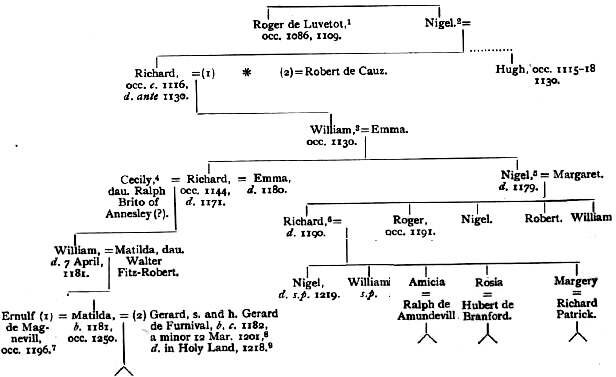
The family of Luvetot came from Louvetot, in Normandy, where lands and the church had been given to St. Wandrille at an early date. The first of the family in England was Roger, the man of Roger de Busli, who held an extensive fee in Nottinghamshire, being part of Busli's honor of Tickhill, and 2 knights' fees in Northamptonshire of the fee of the abbot of Peterborough. He was succeeded by his nephew Richard, son of his brother Nigel. This Richard and his son William attested a confirmation by Henry I to the monastery of Belvoir. In 1130 William de Luvetot accounted for half a year's farm of the honor of Blythe, and for the sum of £226 of the pleas of Geoffrey de Clinton and for the land which Robert de Cauz had held with his (Luvetot's) mother, and also for 200m, for the king's pardon of a plea in which he had been involved at the recent assize of Blythe
William de Luvetot was amerced in 1176 for forest trespass in Nottinghamshire and in respect of Temple Dinsley, also called Dinsley Furnivall, in Hertfordshire. He died in 1181, leaving by Matilda, his wife, daughter of Walter Fitz-Robert, then aged twenty-four, a daughter Matilda, born about 1178, in ward of Ralph Murdac. For many years from 1181 the issues of the land of William de Luvetot were accounted for by the same Ralph, then sheriff of Nottingham. In 1184 he took credit for 40 cows at 5s. each and 4 bulls at 8s. each for restocking 2 vaccaries at "Sefeld" (Sheffield), and for 8 oxen at 8s. each, 12 sows and a boar at 12d. each. He also expended £7 in making a fence round the castle of "Sedfeld" (Sheffield), and £6 for seed-corn for the land of William de Luvetot. The following year he expended 66s. 8d. in repairing Sheffield Castle, which had been destroyed by fire, 62s. in harvesting the corn crop, and paid £10 to William Paynel for his (Murdac's?) relief. In 1186 he accounted for 25s. 8d. of the farm of land, late of Henry de Wulveley, whose heir was in the king's custody, and again 25s. in 1187. In 1188 a gate-keeper and a Serjeant, keeping ward in Sheffield Castle cost £4 10s.
In the famous 12th century Priory church in the town of Worksop, a few battered monumental knightly effigies tell part of the story of how the manor descended to the Norfolks. The Saxon lord was supplanted at the Conquest by Roger de Busli, one of the Conqueror’s most favoured companions. The whole of Hallamshire was also his, but failing descendants, most of the de Busli properties went to their sub-tenants the de Lovetots and these included Worksop and Hallamshire.

William de Lovetot was the son of a Norman baron who had come over with the Conqueror.

The first William de Lovetot, Lord of Hallamshire, was succeeded by his son Richard, whose son and successor, William, died without male issue, about the year 1180, leaving an only daughter, Matilda, then of very tender age, as a ward of the reigning monarch, Henry II, who left it to his successor, Richard I, to select the person to whom her hand should be given; and he, as might have been expected, chose the son of one of his companions in arms, Gerard de Furnival, on whom, by this alliance, the lordship of Sheffield devolved, together with all the other estates of the Lovetots, in the counties of York and Nottingham. While the eldest branch of the de Lovetots thus ended in a female heiress, there was another branch still existing, sprung from the first William, by his younger son, Nigel, one of whose descendents seems to have attempted a recovery of the barony of his great ancestor; for we find that in the 9th of John, (1207,) Gerard de Furnival gave a thousand pounds, and fifteen palfreys, to the King, that he might quietly enjoy those lands to which Nigel de Lovetot made
Domesday Online tells us that Nigel was one of Willam I's doctors.
In the early part of the reign of Henry I., we find William de Lovetot in possession of Hallam, Attercliffe, Sheffield, Grimesthorpe, Greasborough, Worksop., and many other manors which had been of the de Busli fee. He had also acquired interest in Handsworth , Treeton, Whiston , and other places, which had been of the Busli fee. They founded a parish church, and a hospital in Shefffield, t he latter was called St. Leonard’s Hospital, and stood on a little eminence on the east side of the town, still called Spital Hill. The churches which the Lovetots erected on their domains, were, according to the prevailing custom of the times, attached to certain monasteries. That at Sheffield was annexed to the Priory which the Lovetots had founded at Worksop.
Worksop

The jewel of Worksop is the Priory Church of Our Lady and St. Cuthbert, a magnificent Norman building with a unique gatehouse.
Although a parish church existed earlier, the foundation of the monastery was on March 3rd 1103. By 1170 the nave was completed and what survives is 135 feet long as compared with the original church which was 360 feet in length. The founder , Sir William de Lovetot, ordered it to be dedicated to St. Cuthbert, the further dedication to the Virgin Mary coming later. The monastic order established there was Augustinian. The de Lovetots and their successors in blood the de Furnivals and the Nevills were closely concerned with the Priory and were pious crusading warriors, All that is left to remind us of them are three mutilated effigies of Lord Furnival and his sister and brother-in-law Sir Thomas and Lady Nevill near the south transept.
In 1240 Maud Furnival, heiress of Worksop Manor, financed the building of the Early English Lady Chapel. The de Lovetots, Furnivals and their successors, were also Lords of Sheffield and there have been long links between the two towns.
From 1303 to 1313 John de Tickhill was Prior and during this time was executed the beautifully illuminated Worksop Psalter which is now in New York Library.
In 1539 most of the monastic institutions of England were in course of being dissolved - a euphemism for being knocked down and their possessions siezed. Worksop was lucky for although all the monastic buildings were destroyed the main priory church remained, though reduced in size, together with the wonderful Gatehouse and its shrine. Even after passing to the Augustinians, the Priory remained the parish church as it had been since 1103 which is why it survived and is used for the same purpose today.
Restoration work was carried out on the Priory in the 1920s and and thanks to a handsome legacy from a former Worksop choirboy, John F. Ellis, new additions in modem style have been made to the east end during the 1970s.

The Gatehouse was described as one of the most interesting buildings in the county and is late 13th century.
The exterior is decorated by niches containing statues which depict St. Augustine, St. Cuthbert and other religious imagery.
The south east corner has a decorated projection which was a shrine probably containing a holy relic and a statue of Our Lady.
« Genealogy Index
« History Index
The Dukeries and Sherwood Forest
Worksop Manor